
Hire Employees in Bahrain
2026 EOR, Payroll and Employment Guide
Yes — but not on a foreign payroll. Work performed in Bahrain requires a local legal employer: your own WLL, or an Employer of Record. Bahrain is the only Gulf market where the employer contribution rate rises on a published annual schedule, so multi-year models need building with that escalation in.
This guide covers the hiring-model decision, 2026 employer contributions and ceilings, payroll and income tax, working time and leave, termination and severance, immigration routes and the compliance risks that most often catch foreign employers in Bahrain.
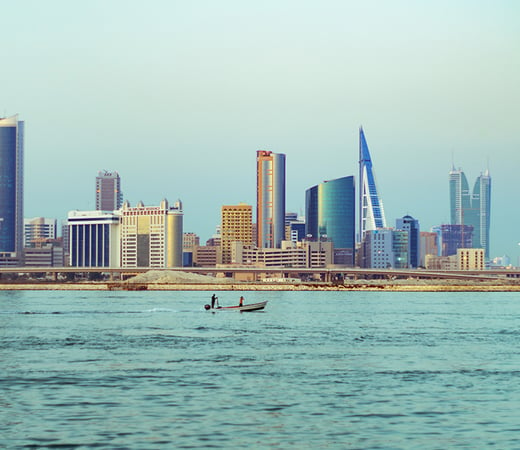
Can a foreign company hire employees in Bahrain?
Yes — but not on a foreign payroll. Work performed in Bahrain requires a local legal employer: your own WLL, or an Employer of Record. Bahrain is the only Gulf market where the employer contribution rate rises on a published annual schedule, so multi-year models need building with that escalation in.
Your own entity is normally a WLL. Bahrain has no corporate tax and no personal income tax, so the social insurance position is effectively the whole payroll picture.
An Employer of Record inverts the sequence: the Bahraini entity signs the Arabic contract, registers with the SIO, applies the correct rate for the employee’s category and remits the expatriate end-of-service contributions monthly — while you direct the day-to-day work.
Bahrain runs three distinct contribution categories — Bahraini nationals, non-GCC expatriates, and GCC nationals following their home country rules. Classifying an employee correctly is the first step rather than a detail.
Sources: Ministry of LabourTamkeenGX operating experience — Bahrain EOR payrollverified 27 August 2026
EOR, entity or contractor — which model fits?
Use an EOR for speed and low headcount; incorporate once Bahrain is a settled regional base. Bahrain has no corporate tax and no personal income tax, so the social insurance position is effectively the whole payroll picture.
Bahrain is the only Gulf market where employer cost rises on a published schedule, and multi-year models have to build that in. Law No. 14 of 2022 raises the employer contribution for Bahraini nationals by one percentage point every January — 17% in 2025, 18% in 2026, continuing through 2028. The employee side has been fixed at 8% since 2023, so only the employer figure moves.
It stops at 20% in January 2028. The schedule runs 15% in 2023 through to 20% in 2028, a point a year; the 21% figure that appears in some reporting applies to voluntarily insured persons rather than employers. Bahraini nationals working elsewhere in the GCC attract 15% in 2026, reaching 17% by 2028.
For expatriates the position changed materially in March 2024. Resolution No. 109 of 2023 replaced lump-sum end-of-service gratuity with monthly contributions to an SIO-administered fund at 4.2% of wage for the first three years and 8.4% thereafter. That converts a back-loaded liability into a predictable monthly cost, which is easier to budget but harder to defer.
Two consequences follow. The rate must step at each employee's third anniversary, and the scheme is not retrospective — service before March 2024 leaves a legacy gratuity entitlement that still needs provisioning separately alongside the funded portion.
| Employer of Record | Own entity | Contractor | |
|---|---|---|---|
| Time to first hire | 1–2 weeks | 2–4 months (incorporation, registrations, bank account) | Days — but only for genuinely independent work |
| Upfront cost | None — monthly fee per employee | Incorporation, capital, accounting and payroll setup | None |
| Ongoing obligations | EOR runs payroll, withholding, social contributions and statutory filings | Full local payroll, corporate tax and statutory filings | Invoice-based; contractor handles own tax |
| Work-permit sponsorship | Yes — EOR sponsors as legal employer | Yes — your entity sponsors | No |
| Misclassification risk | Low — statutory employment | Low — statutory employment | High if the role is employee-like — run the risk check |
| Best for | First 1–20 hires, market testing, speed | Permanent operations, local invoicing, larger teams | Short, independent, project-based engagements |
Break-even rule of thumb: EOR fees begin to exceed the running cost of a small Bahraini entity somewhere between 15 and 20 employees. Model both before committing — see EOR vs Entity for the full comparison, and plan any later migration so employees keep seniority.
Sources: Ministry of LabourTamkeenGX operating experience — Bahrain EOR payrollverified 27 August 2026
How Employer of Record hiring works in Bahrain
How much does it cost to employ someone in Bahrain?
For a Bahraini national, 18% of insurable wage in 2026 — rising a point every January. For a non-GCC expatriate, 3% for work injury plus 4.2% to the end-of-service fund for the first three years and 8.4% thereafter.
Bahrain is the only Gulf market where employer cost rises on a published schedule. Law No. 14 of 2022 raises the employer contribution for Bahraini nationals by one percentage point every January — 17% in 2025, 18% in 2026, continuing through 2028. The employee side has been fixed at 8% since 2023.
It stops at 20% in January 2028. The schedule runs 15% in 2023 through to 20% in 2028, a point a year; the 21% figure that appears in some reporting applies to voluntarily insured persons rather than employers. Bahraini nationals working elsewhere in the GCC attract 15% in 2026, reaching 17% by 2028.
For expatriates the position changed in March 2024. Resolution No. 109 of 2023 replaced lump-sum gratuity with monthly contributions to an SIO-administered fund at 4.2% of wage for the first three years and 8.4% thereafter. All contributions are calculated on insurable wage capped at BHD 4,000 a month.
Sources: Social Insurance Organisation (SIO)Law No. 14 of 2022Resolution No. 109 of 2023Social Insurance Organisation - Law No. 14 of 2022Labour Law 36 of 2012National minimum wage instrument 2026Employer contribution schedule 2026verified 27 August 2026
2026 mandatory employer contributions
| Contribution | Total rate | Employer share | 2026 cap | Effective cost |
|---|---|---|---|---|
| SIO — Bahraini nationals, employer | 18% | 18% employer / 8% employee | BHD 4,000/month | Combined 26% |
| SIO — Bahraini nationals, employee | 8% | 100% employee | BHD 4,000/month | 7% pension plus 1% unemployment |
| Annual escalator | +1 point each January | — | — | Law No. 14 of 2022 |
| Escalator endpoint | 20% or 21% by January 2028 | — | — | See note |
| Non-GCC expatriates — work injury | 3% | 3% employer / 1% employee | BHD 4,000/month | Combined 4% |
| Non-GCC expatriates — EOSB fund, years 1–3 | 4.2% of wage | 100% employer | BHD 4,000/month | Equivalent to half a month a year |
| Non-GCC expatriates — EOSB fund, year 4 onward | 8.4% of wage | 100% employer | BHD 4,000/month | Equivalent to a month a year |
| Employer total — expatriate | 7.2% or 11.4% | — | BHD 4,000/month | 3% work injury plus the EOSB rate |
| Bahraini nationals working in other GCC states | 15% employer / 7% employee | — | — | Rising to 17% by January 2028 |
| GCC nationals working in Bahrain | Per home country rules | — | — | Not the Bahraini rate |
| Insurable wage cap | BHD 4,000/month | — | — | All categories |
| Bahraini nationals — 2027 | 19% | 100% employer | BHD 4,000/month | Law No. 14 of 2022 |
| Bahraini nationals — 2028 | 20% | 100% employer | BHD 4,000/month | The end point of the schedule |
| GCC nationals — 2026 | 15% | 100% employer | BHD 4,000/month | Rising to 17% by 2028 |
| Non-GCC expatriates | 3% | Work injury only | BHD 4,000/month | No pension or unemployment |
| Expatriate EOSB — to 3 years | 4.2% | Monthly to the SIO | — | Half a month per year |
| Expatriate EOSB — beyond 3 years | 8.4% | Monthly to the SIO | — | A full month per year |
| EOSB mechanism | Monthly funding | Since 1 March 2024 | — | Replaced the termination lump sum |
| GCC nationals from another state | Home-country rules | Not the host rate | — | Employer share capped at the host share |
| Cross-border difference | Borne by the employee | Where home exceeds host | — | Confirm per employee |
| End-of-service base | funded monthly to the SIO rather t | No single GCC rule | — | Averaging causes disputes |
Worked example
| Monthly insurable wage (expatriate, year 2) | BHD 1,500 |
| Work injury 3% | BHD 45 |
| EOSB fund 4.2% | BHD 63 |
| Total employer cost above wage | BHD 108 |
| Annualised employer cost | 12 × the monthly total above |
| What this figure excludes | Recruitment, equipment, benefits and any employer-funded sick pay |
Bahrain employer-cost calculator
Enter a gross monthly salary to see the breakdown.
What does a real hire cost? Benchmarks by role
Software engineer (expatriate, year 2) and Operations analyst (Bahraini national) sit at opposite ends of the range below. The on-cost percentage is what to read here — watch how it behaves as pay rises, since capped contributions fall away as a share of salary while uncapped ones do not.
Four representative profiles, costed with the 2026 contribution rates above. Salaries are illustrative market midpoints, not GX operating data — use them to see how the on-cost percentage behaves as pay rises, not as a salary benchmark for a specific role. For real market data on your roles, ask for a costing.
Because the main charges are capped, the on-cost percentage falls sharply above the ceiling. Model a senior hire explicitly rather than scaling the junior figure — the error runs in your favour but it distorts the comparison against uncapped markets.
Four representative profiles costed on 2026 statutory rates. Salaries are illustrative market midpoints, not GX operating data.
Sources: Ministry of Industry & Commerceverified 27 August 2026
How Bahrain compares & employer on-costs in the Gulf
Indicative 2026 statutory employer rates on typical professional salaries, before benefits and 13th-month customs. Full country data: hiring in Omanhiring in Saudi Arabia.
How do payroll, income tax and the 13th month work?
Payroll runs monthly in dinars through the Wage Protection System. There is no personal income tax and no corporate tax, though VAT applies at 10%. SIO contributions are due by the fifteenth of the following month.
Payroll runs monthly in dinars through the LMRA-regulated Wage Protection System. There is no personal income tax, though VAT applies at 10%.
SIO contributions are due by the fifteenth of the following month, and the consequence of lateness goes beyond interest. Penalties accrue as a percentage plus monthly interest, and persistent delays can block commercial licence renewal — which makes the deadline a business-continuity matter rather than an administrative one.
Insurable wage covers basic salary and regular allowances but generally excludes overtime, bonuses and certain travel allowances, so the pay structure needs checking against SIO guidance rather than assumed.
Pay frequency
Monthly payroll in BHD. Salary must be paid within the statutory period after the pay reference period ends; late payment carries interest or penalty in most jurisdictions.
Payslips
An itemised payslip is required, showing gross pay, each statutory deduction and net pay. Electronic delivery is accepted where the employee can retain a copy.
13th-month salary
No statutory 13th month in Bahrain. Where a collective agreement or contract provides one it becomes enforceable, so check the applicable agreement before quoting total cost.
Income tax withholding
Employers withhold income tax at source across a flat 10% and remit with the periodic return. Rates and thresholds are set out in the bracket table below.
Sources: Social Insurance Organisation (SIO)National Bureau for RevenueSocial Insurance Organisation - Law No. 14 of 2022National minimum wage instrument 2026verified 27 August 2026
2026 personal tax position
The figures below drive the employee side of the calculation and the employer’s withholding obligation. Rates are refreshed at the start of each tax year.
Thresholds and ceilings are uprated periodically, so a figure correct in January may not hold later in the year. Where a row below is flagged, published sources disagreed and the conflict is recorded rather than resolved.
Thresholds move on a local cycle that does not always fall in January, so a figure correct at the start of the year may not hold through it. Where a row below carries a flag, published sources disagreed and the conflict is recorded rather than resolved — there are 1 such rows on this page.
| Band | Rate |
|---|---|
| Personal income tax | None |
| Corporate income tax | 0% |
| VAT | 10% |
| Payment deadline | 15th of the following month |
| Wage Protection System | Mandatory |
Resident rates run 10% to 10%. Non-residents are taxed at a flat 10%.
What does Bahraini labor law require?
The Labour Law for the Private Sector governs the relationship. Annual leave is 30 days, and the end-of-service benefit for expatriates has been restructured into a monthly funded scheme.
The sections that follow set out contracts and probation, working time, leave, termination and immigration in that order. Where an entitlement comes from a collective agreement rather than statute it is marked as such, because that distinction determines whether it is negotiable.
Sources: Ministry of LabourLMRAverified 27 August 2026
Contracts & probation
A written contract in Arabic is standard and registered with the Ministry of Labour, with Arabic governing where a translation differs.
Probation is three months, extendable to six for certain roles by agreement. SIO registration and contributions apply from the first day regardless of probationary status, so the obligation and the protection do not begin together.
For expatriates the exact service start date should be recorded precisely, because the end-of-service fund rate doubles from 4.2% to 8.4% at the third anniversary and the step needs to happen automatically rather than being noticed.
Working hours & overtime
Eight hours a day and forty-eight a week, reduced to six hours a day during Ramadan for Muslim employees. Overtime carries a premium of at least 25% for daytime hours and 50% at night, with higher rates for rest days and public holidays.
Overtime is where payroll disputes usually start. Record hours from day one even where the role is salaried and the expectation is that overtime will not arise — reconstructing records after a complaint is far harder than keeping them.
Overtime is where payroll disputes usually begin, and the burden of proving hours worked generally sits with the employer. Record hours from the first day even for salaried roles where overtime is not expected — reconstructing a record after a complaint is considerably harder than keeping one.
Annual leave
| Tenure | Paid annual leave |
|---|---|
| Annual leave | 30 days a year |
| Qualifying period | Available after one year of service, accruing pro rata before that |
| Payment | Calculated on basic wage plus social allowance |
| Accrual during the first year | Pro rata by completed month of service in most cases |
| Carry-over | Carried or paid out; varies by market |
| Payment basis | Normal remuneration unless the statute directs otherwise |
Public holidays
Bahrain observes 14 public holidays in 2026. 10 of them move each year, set by a lunar, Islamic or Orthodox calendar, so the dates must be confirmed annually rather than carried forward.
Public holidays sit on top of the annual leave entitlement. Where a holiday falls at a weekend, practice varies — some markets move it, some grant a substitute day and some do neither, so check the position before assuming a day in lieu.
The 14 dates below are the statutory position. Employers in many markets grant more by policy or collective agreement, and sector agreements sometimes add local or patronal days that do not appear in a national list.
Bahrain observes 14 paid public holidays in 2026. Dates that fall at a weekend and any substitution rules are set out below; entitlement is separate from annual leave.
| Holiday | Date (2026) |
|---|---|
| New Year’s DayFixed national holiday | Thu 1 Jan |
| Eid al-Fitr — day 1Date set by the Islamic calendar, confirmed by official announcement | Fri 20 Mar |
| Eid al-Fitr — day 2Date set by the Islamic calendar, confirmed by official announcement | Sat 21 Mar |
| Eid al-Fitr — day 3Date set by the Islamic calendar, confirmed by official announcement | Sun 22 Mar |
| Labour DayFixed national holiday | Fri 1 May |
| Eid al-Adha — day 1Date set by the Islamic calendar, confirmed by official announcement | Wed 27 May |
| Eid al-Adha — day 2Date set by the Islamic calendar, confirmed by official announcement | Thu 28 May |
| Eid al-Adha — day 3Date set by the Islamic calendar, confirmed by official announcement | Fri 29 May |
| Islamic New YearDate set by the Islamic calendar, confirmed by official announcement | Tue 16 Jun |
| Ashura — day 1Date set by the Islamic calendar, confirmed by official announcement | Wed 24 Jun |
| Ashura — day 2Date set by the Islamic calendar, confirmed by official announcement | Thu 25 Jun |
| Prophet Muhammad’s BirthdayDate set by the Islamic calendar, confirmed by official announcement | Tue 25 Aug |
| National Day — day 1Fixed national holiday | Wed 16 Dec |
| National Day — day 2Fixed national holiday | Thu 17 Dec |
Family & sick leave
Maternity: 60 days paid, plus 15 days unpaid — Employer-funded. Nursing breaks: 2 hours a day for the first 6 months, then 1 hour to 24 months — Paid. Paternity: 1 day — Employer-paid. Sick leave: Up to 55 days a year on a graduated scale — 15 days full pay, 20 days half pay and 20 days unpaid.
Ramadan hours: 6-hour working day for Muslim employees — Statutory.
The question that matters for budgeting is who funds each entitlement. Where the state or a social insurance fund pays, the employer carries administration but not cost; where the employer pays, it is a direct charge that headcount models routinely omit. Both patterns appear above.
| Leave | Entitlement | Pay |
|---|---|---|
| Maternity | 60 days paid, plus 15 days unpaid | Employer-funded |
| Nursing breaks | 2 hours a day for the first 6 months, then 1 hour to 24 months | Paid |
| Paternity | 1 day | Employer-paid |
| Sick leave | Up to 55 days a year on a graduated scale | 15 days full pay, 20 days half pay and 20 days unpaid |
| Ramadan hours | 6-hour working day for Muslim employees | Statutory |
| Marriage leave | Set by statute, collective agreement or policy | Commonly 1 to 5 days where provided |
| Bereavement leave | By relationship to the deceased | Commonly 1 to 5 days, paid where provided |
| Family care leave | For a dependent child or relative | Statutory in some markets, contractual in others |
| Study and training leave | Where the employer sponsors the training | By agreement, and paid in most arrangements |
Termination, notice & severance
For expatriates hired since March 2024 the exit position is simple: the accumulated SIO fund is released, and there is no separate lump sum to compute. The employer's obligation was discharged monthly.
For anyone with service predating the scheme, the legacy entitlement applies to that earlier period and must be calculated and paid alongside the fund balance. Employers who assumed the funded scheme covered the whole tenure find the shortfall at exit rather than in provisioning.
The Labour Law for the Private Sector requires a valid reason for dismissal and notice by length of service. Arbitrary dismissal exposes the employer to compensation determined by the labour court, and probation — three months, extendable to six for certain roles — is the window in which that risk is lowest.
SIO registration and contributions apply from the first day regardless of probationary status.
How do work permits and visas work in Bahrain?
Expatriates need an LMRA work permit sponsored by the employer, alongside a residence permit. Bahrainisation targets apply by sector and affect permit entitlement.
Expatriates need an LMRA work permit sponsored by the employer alongside a residence permit. Allow four to eight weeks.
Bahrainisation targets apply by sector and affect permit entitlement, monitored by the LMRA. The position should be checked before making an expatriate offer rather than after, because a shortfall can block the permit entirely.
GCC nationals need no work permit but their social insurance follows their own country’s regulations, which is a separate calculation from both the Bahraini and expatriate positions.
| Route | Who it fits | Key criteria | Notes |
|---|---|---|---|
| LMRA work permit | Expatriate employees | Employer-sponsored, alongside a residence permit | Allow 4 to 8 weeks |
| Bahrainisation targets | All employers | Sector quotas affecting permit entitlement | Monitored by the LMRA |
| GCC nationals | Citizens of GCC member states | No work permit required | Social insurance follows home country rules |
Sources: Labour Market Regulatory Authority (LMRA)Information & eGovernment Authorityverified 27 August 2026
What are the main compliance risks when hiring in Bahrain?
The risks that actually catch foreign employers here: using the 2025 employer rate; EOSB rate not stepped at year four; pre-March 2024 expatriate service overlooked; wrong category applied; SIO payment late. 4 of the five carry high severity.
Two timing failures dominate. The employer rate must be updated every January under the legislated escalator, and the expatriate end-of-service rate must step at each employee’s third anniversary. Both are predictable and both are missed by payroll left unreviewed.
The third is scope. The March 2024 end-of-service scheme is not retrospective, so service before that date leaves a legacy gratuity entitlement that must be calculated and paid alongside the fund balance. Employers who assume the funded scheme covers the whole tenure discover the shortfall at exit.
Practical controls: classify every employee into one of the three categories at onboarding, diarise the January rate change and each third anniversary, provision separately for pre-March 2024 service, and treat the SIO payment date as a licence-renewal risk rather than a filing deadline.
Sources: Social Insurance Organisation (SIO)Labour Market Regulatory Authority (LMRA)Labour Law 36 of 2012verified 27 August 2026
Contractor misclassification risk check
Answer for the Bahrain-based person you currently pay as a contractor. Indicative only — not legal advice.
Compliant onboarding checklist
Work backwards from the start date. For someone already resident, one to two weeks is realistic. A new expatriate hire adds four to eight weeks for the LMRA work permit and residence permit.
Confirm before making an offer: which of the three categories the employee falls into, since Bahraini nationals, GCC nationals and non-GCC expatriates are treated entirely differently; the Bahrainisation quota position, which determines permit entitlement; and the exact service start date, because the EOSB rate doubles at the third anniversary.
SIO contributions are due by the fifteenth of the following month, and persistent lateness can block commercial licence renewal. That makes the deadline a business-continuity matter rather than an administrative one. Salaries must be paid through the LMRA-regulated Wage Protection System.
Hiring in Bahrain & frequently asked questions
No. An Employer of Record employs the worker through its own Bahraini entity, registers with the SIO and sponsors the LMRA work permit. Your own WLL makes sense once Bahrain is a settled regional base.
Yes, through a Bahrain EOR without incorporating, or by establishing a WLL. Bahrain has no corporate tax and no personal income tax, so the social insurance position is effectively the whole payroll picture.
Yes, on the same basis as any foreign company. Bahraini law governs work performed there, including SIO contributions and the Labour Law for the Private Sector.
Through an EOR, typically one to two weeks for someone already resident. A new expatriate hire adds four to eight weeks for the LMRA work permit and residence permit, and the Bahrainisation position should be checked first.
For a Bahraini national, 18% of insurable wage in 2026. For a non-GCC expatriate, 3% for work injury plus 4.2% to the end-of-service fund in the first three years, or 8.4% thereafter — so 7.2% or 11.4% in total.
Because Law No. 14 of 2022 put it on a legislated escalator, raising the employer contribution by one percentage point each January. It went from 17% in 2025 to 18% in 2026 and continues through 2028. Sources differ on whether the endpoint is 20% or 21%.
8% of insurable wage — 7% for pension and 1% for unemployment. That has been unchanged since January 2023, so only the employer side is rising.
Only for work injury, at 1% employee and 3% employer. Non-GCC expatriates have no pension or unemployment entitlement, but they are covered by the separate end-of-service benefit scheme.
Resolution No. 109 of 2023 replaced the traditional lump sum with monthly employer contributions to an SIO-administered fund from 1 March 2024. The rate is 4.2% of wage for the first three years of service and 8.4% thereafter, and the accumulated fund is paid out on the end of service or departure.
No. The obligation is not retrospective, so an employee with tenure predating the scheme has a legacy gratuity entitlement alongside the funded portion. Both need provisioning.
They contribute according to their own country's social security regulations rather than the Bahraini rates. Separately, Bahraini nationals working elsewhere in the GCC attract a 15% employer contribution in 2026, rising to 17% by January 2028.
Yes, at BHD 4,000 of monthly insurable wage across all categories. Insurable wage covers basic salary and regular allowances but generally excludes overtime, bonuses and certain travel allowances.
No. Bahrain does not tax employment earnings, and corporate tax is zero other than for oil and gas activities. VAT applies at 10%.
Monthly, in dinars, and salaries must be paid through the LMRA-regulated Wage Protection System. SIO contributions are due by the fifteenth of the following month.
A penalty applies as a percentage of the amount due plus monthly interest, and persistent delays can block commercial licence renewal — which makes the deadline a business-continuity matter rather than an administrative one.
No. Bonuses are contractual.
Eight hours a day and forty-eight a week, reduced to six hours a day during Ramadan for Muslim employees. Overtime carries at least 25% for daytime hours and 50% at night, with higher rates for rest days and public holidays.
Thirty days a year, available after one year of service and accruing pro rata before that. It is calculated on basic wage plus social allowance.
Around fourteen in 2026, most set by the Islamic calendar. National Day in December runs across two days, and Ashura is observed over two days.
Yes, three months, extendable to six for certain roles by agreement. SIO registration and contributions apply from the first day regardless of probationary status.
The full 2026 Bahrain hiring guide — rates, tables and checklists — formatted for sharing with your finance and legal teams.
Sources: verified 27 August 2026
Terms used on this page
Sources: verified 27 August 2026
How this guide is compiled and verified
Every figure is taken from the primary Bahrain government source, checked against GX’s in-country payroll operation, and dated. This guide was last reviewed on 27 August 2026, and is next scheduled for review in February 2027 — or immediately if rates change in between.
- Social Insurance Organisation (SIO) — Contribution rates by category, the annual escalator, the insurable wage cap and the EOSB fund
- Law No. 14 of 2022 — The schedule raising employer contributions by one point each January
- Resolution No. 109 of 2023 — The end-of-service benefit scheme for non-Bahrainis, effective 1 March 2024
- Labour Market Regulatory Authority (LMRA) — Work permits, Bahrainisation targets and the Wage Protection System
- Ministry of Labour — Labour Law for the Private Sector, working time, leave and termination
- National Bureau for Revenue — VAT, and confirmation that no personal income tax applies
- Social Insurance Organisation - Law No. 14 of 2022 — Employer contribution rates, ceilings and eligibility conditions for 2026 as applied on this page. · verified 17 Aug 2026
- LMRA — Statutory employment framework as enacted · verified 17 Aug 2026
- Labour Law 36 of 2012 — Occupational risk, health cover or supplementary scheme rules · verified 17 Aug 2026
- Information & eGovernment Authority — Work permits, visas and residence for foreign hires · verified 17 Aug 2026
- Ministry of Industry & Commerce — Wage and employment statistics used for role benchmarks · verified 17 Aug 2026
- Tamkeen — Entity incorporation and company registration · verified 17 Aug 2026
- GX operating experience — Bahrain EOR payroll — Onboarding timelines, EOR fee structure and practical employer obligations observed in live payrolls. · verified 17 Aug 2026
- Bahrain public holiday calendar 2026 — Statutory public holiday dates and substitution rules applied to the 2026 calendar. · verified 17 Aug 2026
- National minimum wage instrument 2026 — Minimum wage level in force for 2026 and the instrument that set it. · verified 17 Aug 2026
- Employer contribution schedule 2026 — Contribution rates, ceilings and floors applied in the cost calculator on this page. · verified 17 Aug 2026
- Termination and severance provisions — Notice periods, severance formulas and procedural requirements on dismissal. · verified 17 Aug 2026
Read our editorial policy, corrections policy and CountryPedia methodology.
Sources: verified 27 August 2026
Ready to hire in Bahrain?
GX employs your candidates compliantly in Bahrain — contract, payroll, contributions and filings handled by our local entity.